

ISSN 0248-1294 print and 1625-967X online | © ISHS 2018 | Fruits, The International Journal of Tropical and Subtropical Horticulture | Original article
Retention of green colour of tomatoes marketed as a green vegetable at ambient conditions in Cambodia with modified atmosphere storage and fumigation with 1.methylcyclopropene (1.MCP)
Sonnthida Sambath1,2, R.B.H. Wills1,a, V.V.V. Ku1and S. Newman3.
1 School of Environmental and Life Sciences, University of Newcastle, Ourimbah NSW 2258, Australia
2 Cambodian Agriculture Research and Development Institute, Phnom Penh, Cambodia
3 NSW Department of Primary Industries, Ourimbah NSW 2258, Australia
|
SUMMARY
Introduction – Unripe, green tomatoes are marketed in Cambodia but have a short market life due to rapid ripening under tropical temperatures and the unavailability of refrigerated technology. This paper examines the potential for storage in modified atmospheres (MA) and/or fumigation with 1-MCP to extend the green life of tomatoes held at ambient tropical conditions. Materials and methods – Laboratory studies were conducted in Australia at 25 °C with ‘Neang Pich’ tomatoes to determine the optimum conditions for fumigation with 1-MCP and controlled atmospheres (CA) to delay loss of green colour. A commercial polyethylene film bag was identified to generate the desired atmosphere and field trials with the bag were then conducted in Cambodia under ambient conditions (25 to 35 °C) to determine the extension in green life of ‘Mongal’ and ‘Plai Bi’ tomatoes. Results and discussion – Maximum retention of green life was achieved either by fumigation with 1 μL L-1 1-MCP for 1 h, or by storage in 5% oxygen and 10% carbon dioxide, but no cumulative benefit combining the two treatments was observed. MA storage was considered the most viable technology in Cambodia and field trials in Cambodia found the green life increased from the 2–3 days when held in air to 7–9 days in the MA bag. Conclusions – Use of MA with a plastic bag offers an easy to implement technology for Cambodian farmers to delay the loss of green life of tomatoes and thereby greatly increase marketing options.
Résumé
Keywords Cambodia, tomato, Lycopersicon esculentum,green life, plastic film bags, tropical climate conditions Mots clés Cambodge, tomate, Lycopersicon esculentum, vie en vert, film plastique, conditions climatiques tropicales
|
Significance of this study
What is already known on this subject?
|

|


|
E-mail: ron.wills@newcastle.edu.au
References
CARDI (2007). Tomato variety Neang Pech. Cambodian Agricultural Research and Development Institute. www.cardi.org.kh/?page=document&&cateid=71&lg=en.
Genova, C., Weinberger, K., Sokhom, S., Vanndy, M., and Yarath, C.E. (2006). Postharvest loss in the supply chain for vegetables: The case of tomato, yardlong bean, cucumber and Chinese kale in Cambodia. AVRDC Working Paper No. 16 (Shanhua, Taiwan: World Vegetable Center).
Hickey, M. (2010). Improvement of vegetable production and postharvest practice in Cambodia and Australia. Final report for project HORT/2003/045 (Canberra: ACIAR). http://aciar.gov.au/publication/fr2010-07.
Li, Y., Wills, R.B.H., and Golding, J.B. (2017). Storage at elevated ambient temperature and reduced ethylene delays degreening of Persian limes. Fruits 72, 288–291. https://doi.org/10.17660/th2017/72.5.4
MAFF (2017). Daily Price of Agricultural Products. (Phnom Penh, Cambodia: Ministry of Agriculture, Food and Fisheries). http://www.maff.gov.kh/.
Mathooko, F.M., and Nabawanuka, J. (2003). Effect of film thickness on postharvest ripening and quality characteristics of tomato (Lycopersicon esculentum L.) fruit under modified atmosphere packaging. J. Agric. Sci. Technol. 5, 39–60.
Mostofi, Y., Toivonen, P.M.A., Lessani, H., Babalar, M., and Lu, C. (2003). Effects of 1-methylcyclopropene on ripening of greenhouse tomatoes at three storage temperatures. Postharv. Biol. Technol. 27, 285–292. https://doi.org/10.1016/S0925-5214(02)00113-8 .
Paul, V., Pandey, R., and Srivastava, G.C. (2010). Ripening of tomato (Solanum lycopersicum L.). Part I: 1-methylcyclopropene mediated delay at higher storage temperature. J. Food Sci. Technol. 47, 519–526. https://doi.org/10.1007/s13197-010-0090-5 .
Sabir, F.K. (2012). Postharvest quality response of broccoli florets to combined application of 1-methylcyclopropene and modified atmosphere packaging. Agric. Food Sci. 21, 421–429. https://doi.org/10.23986/afsci.6387 .
Sargent, A.A., and Moretti, C.L. (2016). Tomato. In The commercial storage of fruits, vegetables, and florist and nursery stocks. Agriculture Handbook Nr. 66, K.C. Gross, C.Y. Wang, and M. Saltveit, eds. (Beltsville, MD: USDA-ARS).
Scott, K.J., and Roberts, E.A. (1966). Polyethylene bags to delay ripening of bananas during storage. Aust. J. Expt. Agric. Anim. Husb. 33, 1029–1036.
Sokhen, C., Kanika, D., and Moustier, P. (2004). Vegetable market flows and chains in Phnom Penh. (Montpellier: CIRAD). http://agritrop.cirad.fr/544875/.
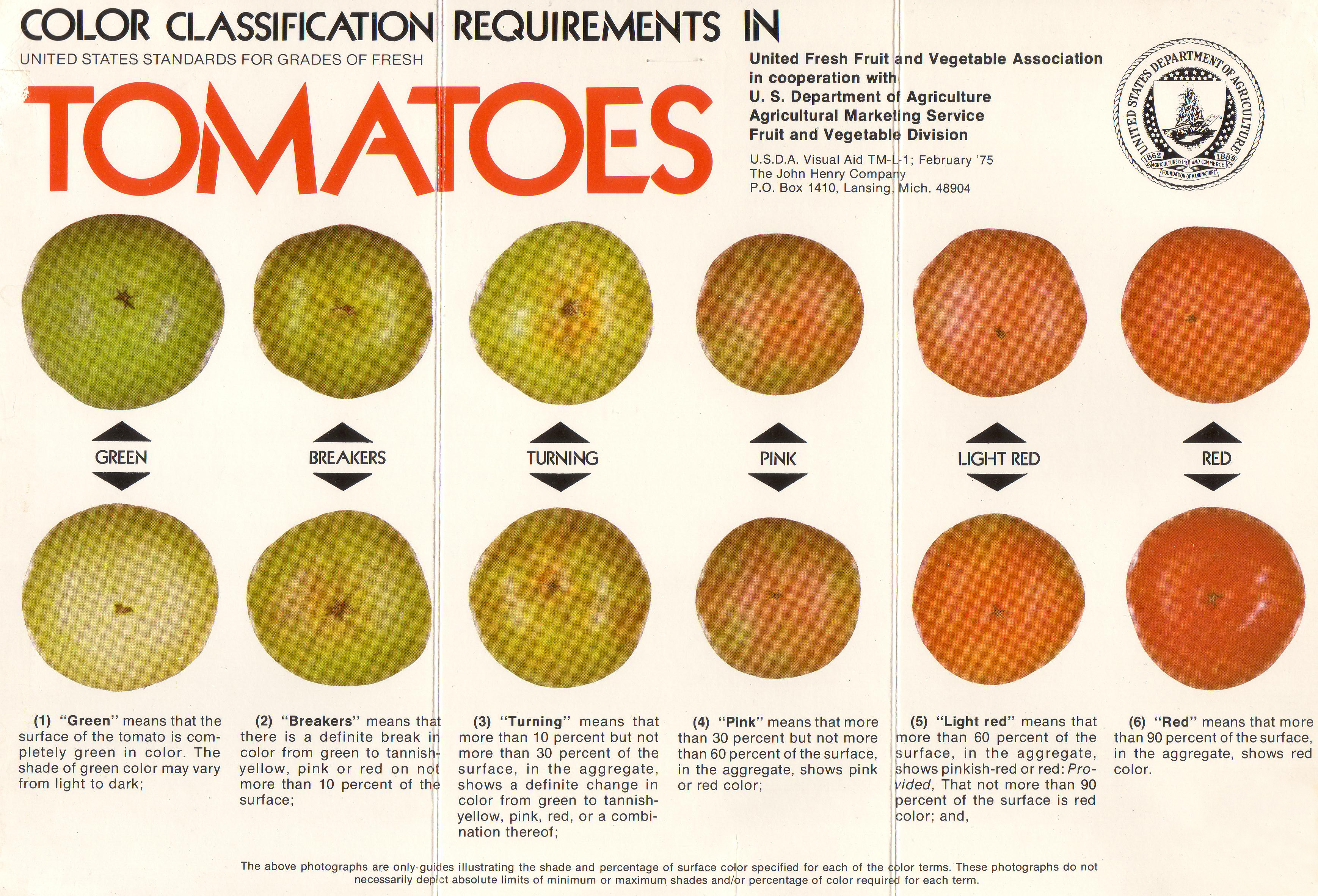
USDA (1975). Color classification requirements in tomatoes. USDA Visual aid TM-L-1. http://ucanr.edu/sites/Postharvest_Technology_Center_/files/223147.jpg.
Vanndy, M., Buntong, B., Chanthasombath, T., Sanatem, K., Acedo, A., and Weinberger, K. (2008). Evaporative cooling storage of tomato in Cambodia and Laos. Acta Hortic. 804, 565–570. https://doi.org/10.17660/ActaHortic.2008.804.83 .
Watkins, C.B. (2015). Advances in the use of 1-MCP. In Advances in Postharvest Fruit and Vegetable Technology, R.B.H. Wills, and J.B. Golding, eds. (Boca Raton, FL: CRC Press), pp. 117–145. https://doi.org/10.1201/b18489-7 .
Wills, R.B.H., and Ku, V.V.V. (2002). Use of 1-MCP to extend the time to ripen of green tomatoes and postharvest life of ripe tomatoes. Postharv. Biol. Technol. 26, 85–90. https://doi.org/10.1016/S0925-5214(01)00201-0 .
Wills, R.B.H., and Golding, J.B. (2016). Postharvest: an Introduction to the Physiology and Handling of Fruit and Vegetables, 6th edn. (Sydney: UNSW Press). https://doi.org/10.1079/9781786391483.0000 .
Wills, R.B.H., Warton, M.A., and Ku, V.V.V. (2000). Ethylene levels associated with fruit and vegetables during marketing. Aust. J. Expt. Agric. 40, 485–490.
Zewter, A., Woldetsadik, K., and Workneh, T.S. (2012). Effect of 1-methylcyclopropene, potassium permanganate and packaging on quality of banana. Afr. J. Agric. Res. 7, 2425–2437. https://doi.org/10.5897/AJAR11.1203 .
Received: 13 May 2018 | Accepted: 21 September 2018 | Published: 12 November 2018 | Available online: 12 November 2018


