

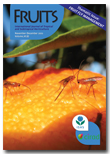
ISSN 0248-1294 print and 1625-967X online | © ISHS 2021 | Fruits, The International Journal of Tropical and Subtropical Horticulture | Original article
Host status of Citrus hystrix, Citrus aurantifolia, Passiflora edulis and Litchi chinensis for Bactrocera dorsalis (Tephritidae, Diptera) on Réunion Island
L. Moquet1, a, and H. Delatte2,3
1 CIRAD, UMR PVBMT, F-97410 St. Pierre, Réunion, France
2 CIRAD, UMR PVBMT, Ambatobe, 101 Antananarivo, Madagascar
3 FOFIFA CENRADERU-DRA, Ambatobe, 101 Antananarivo, Madagascar
|
SUMMARY
Introduction – Determining the host status of fruit species for a given fruit fly species is essential to decide on its risk for the international trade of fresh fruits. This study aims to determine if Bactrocera dorsalis, the Oriental fruit fly, can infest fruits of four commercial species grown for exportation: Citrus aurantifolia, Citrus hystrix, Passiflora edulis and Litchi chinensis in La Réunion. Materials and methods – Fruits of C. aurantifolia, C. hystrix, P. edulis and L. chinensis were collected in the field to determine their natural infestation rates (natural hosts) and laboratory experiments were carried out to study insects’ ability to oviposit and develop in the fruits (conditional hosts). Results and discussion – The two tested Citrus species were neither natural nor conditional hosts for B. dorsalis. Passiflora edulis was a conditional host for B. dorsalis on Réunion Island, as we observed infestations only in experimental conditions. Infestations in experimental and natural conditions by B. dorsalis were observed for L. chinensis. Conclusion – Our findings provided background information on the host status for B. dorsalis for four major fruits candidates for exportation from La Réunion. The risk for export is weak for tested Citrus species because they were neither natural nor conditional hosts for B. dorsalis. On the contrary, the risk for export is not null for L. chinensis and P. edulis, which present infestation by B. dorsalis either in field-collected fruit or in unperforated fruit in the laboratory. As infestations can be difficult to distinguish, post-harvest treatments should be considered to limit the risks. Keywords Bactrocera dorsalis, Citrus, Lychee, Passion fruit, Quarantine pest, La Réunion
|
Significance of this study
What is already known on this subject?
|

|


|
E-mail: helene.delatte@cirad.fr
References
Akamine, E.K., Aragaki, M., Beaumont, J.H., Bowers, F.A.I., Hamilton, R.A., Nishida, T., Sherman, G.D., Shoji, K., Storey, W.B., and Martinez, A.P. (1974). Passion Fruit Culture in Hawaii (University of Hawaii).
Allwood, A.J., and Leblanc, L. (1997). Losses caused by fruit flies (Diptera: Tephritidae) in seven Pacific Island countries. In Aciar Proceedings (Australian Centre for International Agricultural Research), p. 208–211.
Allwood, A.J., Chinajariyawong, A., Drew, R.A.I., and Hamacek, E.L. (1999). Host plant records for fruit flies (Diptera: Tephritidae). Raffles Bull. Zoology 47(7), 1–92.
Armstrong, J.W., and Follett, P.A. (2007). Hot-water immersion quarantine treatment against Mediterranean fruit fly and oriental fruit fly (Diptera: Tephritidae) eggs and larvae in litchi and longan fruit exported from Hawaii. J. Econ. Entomol. 100, 1091–1097. https://doi.org/10.1093/jee/100.4.1091.
Clarke, A.R., Armstrong, K.F., Carmichael, A.E., Milne, J.R., Raghu, S., Roderick, G.K., and Yeates, D.K. (2005). Invasive phytophagous pests arising through a recent tropical evolutionary radiation: The Bactrocera dorsalis complex of fruit flies. Annu. Rev. Entomol. 50, 293–319. https://doi.org/10.1146/annurev.ento.50.071803.130428.
Cowley, J.M., Baker, R.T., and Harte, D.S. (1992). Definition and determination of host status for multivoltine fruit fly (Diptera: Tephritidae) species. J. Econ. Entomol. 85, 312–317. https://doi.org/10.1093/jee/85.2.312.
De Villiers, M., Hattingh, V., Kriticos, D.J., Brunel, S., Vayssières, J.-F., Sinzogan, A., Billah, M.K., Mohamed, S.A., Mwatawala, M., Abdelgader, H., Salah, F.E.E., and De Meyer, M. (2015). The potential distribution of Bactrocera dorsalis: Considering phenology and irrigation patterns. Bull. Entomol. Res. 106, 19–33. https://doi.org/10.1017/S0007485315000693.
Duyck, P.-F., and Quilici, S. (2002). Survival and development of different life stages of three Ceratitis spp. (Diptera: Tephritidae) reared at five constant temperatures. Bull. Entomol. Res. 92, 461–469. https://doi.org/10.1079/BER2002188.
Egartner, A., Lethmayer, C., Gottsberger, R.A., and Blümel, S. (2019). Survey on Bactrocera spp. (Tephritidae, Diptera) in Austria. EPPO Bull. 49, 578–584. https://doi.org/10.1111/epp.12604.
FAO (2016). ISPM 37. Determination of host status of fruit to fruit flies (Tephritidae) (Rome, Italy: Food and Agriculture Organization of the United Nations).
Follett, P.A., Haynes, F.E.M., and Dominiak, B.C. (2021). Host suitability index for polyphagous tephritid fruit flies. J. Econ. Entomol. 114(3), 1021–1034. https://doi.org/10.1093/jee/toab035.
Greany, P.D., Styer, S.C., Davis, P.L., Shaw, P.E., and Chambers, D.L. (1983). Biochemical resistance of Citrus to fruit flies. Demonstration and elucidation of resistance to the Caribbean fruit fly, Anastrepha suspensa. Entomol. Exp. Appl. 34, 40–50. https://doi.org/10.1111/j.1570-7458.1983.tb03288.x.
Han, P., Wang, X., Niu, C.-Y., Dong, Y.-C., Zhu, J.-Q., and Desneux, N. (2011). Population dynamics, phenology, and overwintering of Bactrocera dorsalis (Diptera: Tephritidae) in Hubei Province, China. J. Pest Sci. 84, 289–295. https://doi.org/10.1007/s10340-011-0363-4.
Hassani, I.M. (2017). Etude écologique des mouches des fruits (Diptera: Tephritidae) nuisibles aux cultures fruitières aux Comores. Ph.D. thesis (Université de La Réunion, Université D’Antananarivo).
Iwaizumi, R. (2004). Species and host record of the Bactrocera dorsalis complex (Diptera: Tephritidae) detected by the plant quarantine of Japan. Appl. Entomol. Zool. 39, 327–333. https://doi.org/10.1303/aez.2004.327.
Kwasi, W. (2008). Assessment of fruit fly damage and implications for the dissemination of management practices for mango production in the upper West region of Ghana. J. Dev. Sustain. Agric. 3, 117–134.
Leblanc, L., Vueti, E.T., Drew, R.A., and Allwood, A.J. (2012). Host plant records for fruit flies (Diptera: Tephritidae: Dacini) in the Pacific Islands. Proc. Hawaii. Entomol. Soc. 44, 11–53.
Liquido, N.J., McQuate, G.T., Kurashima, R., Hanlin, M., Birnbaum, A., and Marnell, S. (2015). Provisional list of suitable host plants of oriental fruit fly, Bactrocera dorsalis (Hendel) (Diptera: Tephritidae). In Host Plants of Oriental Fruit Fly (Animal and Plant Health Inspection Service, Plant Epidemiology and Risk), p. 1–47.
Lux, S.A., Copeland, R.S., White, I.M., Manrakhan, A., and Billah, M.K. (2003). A new invasive fruit fly species from the Bactrocera dorsalis (Hendel) group detected in East Africa. Int. J. Trop. Insect Sci. 23, 355–361. https://doi.org/10.1017/S174275840001242X.
Manrakhan, A., Daneel, J.-H., Beck, R., Theron, C.D., Weldon, C.W., Moore, S.D., and Hattingh, V. (2018). Non-host status of commercial export grade lemon fruit (Citrus limon (L.) Burman f. cv. Eureka) for Ceratitis capitata, Ceratitis rosa, Ceratitis quilicii and Bactrocera dorsalis (Diptera: Tephritidae) in South Africa. Afr. Entomol. 26, 202–214. https://doi.org/10.4001/003.026.0202.
McQuate, G.T., and Follett, P.A. (2006). Use of attractants to suppress oriental fruit fly and Cryptophlebia spp. in litchi. Proc. Hawaii. Entomol. Soc. 38, 27–40.
Moquet, L., Payet, J., Glenac, S., and Delatte, H. (2021). Niche shift of tephritid species after the Oriental fruit fly (Bactrocera dorsalis) invasion in La Réunion. Divers. Distrib. 27, 109–129. https://doi.org/10.1111/ddi.13172.
Ndiaye, O. (2009). Plantes hôtes et foyers de réinfestation des mouches des fruits: Facteurs phénologiques, morpho physiologiques déterminants sur les infestations de la mangue (Universite de Thies).
Nugnes, F., Russo, E., Viggiani, G., and Bernardo, U. (2018). First record of an invasive fruit fly belonging to Bactrocera dorsalis complex (Diptera: Tephritidae) in Europe. Insects 9, 182. https://doi.org/10.3390/insects9040182.
Qin, Y., Wang, C., Zhao, Z., Pan, X., and Li, Z. (2019). Climate change impacts on the global potential geographical distribution of the agricultural invasive pest, Bactrocera dorsalis (Hendel) (Diptera: Tephritidae). Clim. Change 155, 145–156. https://doi.org/10.1007/s10584-019-02460-3.
Ruiz, M.J., Juarez, M.L., Alzogaray, R.A., Arrighi, F., Arroyo, L., Gastaminza, G., Willink, E., Bardón, A. del V., and Vera, T. (2014). Toxic effect of citrus peel constituents on Anastrepha fraterculus Wiedemann and Ceratitis capitata Wiedemann immature stages. J. Agric. Food Chem. 62, 10084–10091. https://doi.org/10.1021/jf503063b.
Stephens, A.E.A., Kriticos, D.J., and Leriche, A. (2007). The current and future potential geographical distribution of the oriental fruit fly, Bactrocera dorsalis (Diptera: Tephritidae). Bull. Entomol. Res. 97, 369. https://doi.org/10.1017/S0007485307005044.
Vargas, R.I., Leblanc, L., Putoa, R., and Eitam, A. (2007). Impact of introduction of Bactrocera dorsalis (Diptera: Tephritidae) and classical biological control releases of Fopius arisanus (Hymenoptera: Braconidae) on economically important fruit flies in French Polynesia. J. Econ. Entomol. 100, 670–679. https://doi.org/10.1603/0022-0493(2007)100[670:IOIOBD]2.0.CO;2.
White, I.M., and Elson-Harris, M.M. (1992). Fruit flies of economic significance: Their identification and bionomics. (Wallingford, U.K.: CAB Intl.).
Zeng, Y., Reddy, G.V.P., Li, Z., Qin, Y., Wang, Y., Pan, X., Jiang, F., Gao, F., and Zhao, Z.-H. (2019). Global distribution and invasion pattern of oriental fruit fly, Bactrocera dorsalis (Diptera: Tephritidae). J. Appl. Entomol. 143, 165–176. https://doi.org/10.1111/jen.12582.
Received: 27 June 2021 | Accepted: 1 September 2021 | Published: 7 December 2021 | Available online: 7 December 2021


