

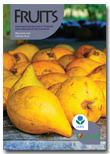
ISSN 0248-1294 print and 1625-967X online | © ISHS 2021 | Fruits, The International Journal of Tropical and Subtropical Horticulture | Original article
Bioactive compounds and antioxidant activity of an endangered Citrus species `Hatkora´ (Citrus macroptera Mont.) from Mizoram, India
E. Lalruatsangi1, T.K. Hazarika1,a, M. Vabeiryureilai2, N. Senthil Kumar2, R. Lalnungrenga3 and Lalnunpuia1
1 Department of Horticulture, Aromatic and Medicinal Plants, Mizoram University, Mizoram, India
2 Department of Biotechnology, Mizoram University, Mizoram, India
3 Silviculture and Forest Management Division, Forest Research Institute, Dehradun, India
|
SUMMARY
Introduction – Crop improvement can be achieved genetically by developing resistant types and devising improvement agronomic practices, by adapting to diverse environments and correcting soil nutrient levels. Use of available genetic resources can be a major part of any crop improvement programme. The success of a breeding program depends on development of improved genotypes through assessment of genetic variability. Bioactive compounds are phytochemical constituents present in fruits having antioxidant, anti-carcinogenic, anti-inflammatory and anti-microbial properties that provide health benefits to human. Materials and methods – The present investigation was conducted to study the genetic variability among 15 Hatkora accessions from Mizoram, India with respect to their biochemical constituents, bioactive compounds and antioxidant activity. The results were analyzed by calculating the respective ‘F’ value and comparing with the appropriate value of ‘F’ at 5% probability level by using Completely Randomized Design (CRD). Results and discussion – Significant differences (p<0.05) were observed among the accessions with respect to all these parameters. The titratable acidity among the accessions ranged between 8.45–11.54 per cent. The TSS content of the fruit ranged between 7.70–9.82 °Brix. The highest value of total sugar, reducing and non-reducing sugars was recorded in MH04T1 (2.83%), MH02T1 (1.26%) and MH04T1 (1.63%). The antioxidant activity using DPPH radical scavenging method ranged from 42.84 to 439.90 µg mL-1 and the highest was observed in MH01T3. Similarly, the antioxidant activity by using ABTS radical scavenging method ranged between 61.98–197.20 µg mL-1 and MH01T3 had the highest value. The total flavonoid content ranges from 13.05–20.98 mg g-1 and among all the accessions, MH04T1 had the highest flavonoid content of 20.98 mg g-1. The total phenolics ranged between 107.54–175.20 mg g-1 and the highest phenolic content is observed in MH04T1. The variability among different accessions might be attributed to the environmental conditions and genetic makeup of the genotypes. Conclusion – This study is the first report about the antioxidant activity, total flavonoid and total phenolic content of Hatkora. The wide range of variation in all these parameters of Hatkora fruits indicated the great scope of individual plant selection based on these characters for future genetic improvement programme. Keywords ABTS, antioxidant activity, biochemical constituents, Citrus macroptera, DPPH, flavonoids, phenolics
|
Significance of this study
What is already known on this subject?
|

|


|
E-mail: tridip28@gmail.com
References
Bayili, R.G., Abdoul-Latif, F., Kone, O.H., et al. (2011). Phenolic compounds and antioxidant activities in some fruits and vegetables from Burkina Faso. Afr. J. Biotechnol. 10, 13543–13547. https://doi.org/10.5897/AJB10.2010.
Chen, Q., Wang, D., Tan, C., Hu, Y., Sundararajan, B., and Zhou, Z. (2020). Profiling of flavonoid and antioxidant activity of fruit tissues from 27 Chinese local Citrus cultivars. Plants 9, 196. https://doi.org/10.3390/plants9020196.
Du, Q.Z., and Chen, H. (2010). The methoxyflavones in Citrus reticulata Blanco cv. Ponkan and their antiproliferative activity against cancer cells. Food Chem. 119, 567–572. https://doi.org/10.1016/j.foodchem.2009.06.059.
Freed, M. (1966). Methods of Vitamin Assay (New York: Interscience Publ. Inc.).
Ghafar, M.F.A., Prasad, K.N., Weng, K.K., and Ismail, A. (2010). Flavonoid, hesperidine, total phenolic contents and antioxidant activities from Citrus species. Afr. J. Biotechnol. 9(3), 326–330.
Grover, J.K., Yadav, S., and Vats, V. (2002). Medicinal plants of India with anti-diabetic potential. J. Ethnopharmacol. 81, 81–100. https://doi.org/10.1016/S0378-8741(02)00059-4.
Hazarika, T.K. (2012). Citrus genetic diversity of north-east India, their distribution, ecogeography and ecobiology. Genet. Res. Crop. Evol. 59, 1267–1280. https://doi.org/10.1007/s10722-012-9846-2.
Hazarika, T.K., Lalawmpuii, B., and Nautiyal, B.P. (2013). Studies on variability in physic chemical characters of hatkora (Citrus macroptera Mont.) collections of Mizoram. Indian J. Hortic. 70, 480–484.
Hazarika, T.K., Lalchhanmawia, J., Lalrinfeli, C., Lalthlamuani, C., Shukla, A.C., and Nautiyal, B.P. (2017). Assessment of genetic variability in the endangered Citrus macroptera Mont. (‘hatkora’) from Mizoram, North East India. Genet. Res. Crop Evol. 63(2), 321–330. https://doi.org/10.1007/s10722-015-0354-z.
Huang, Y.S., and Ho, S.C. (2010). Polymethoxy flavones are responsible for the anti- inflammatory activity of citrus fruit peel. Food Chem. 119, 868–873. https://doi.org/10.1016/j.foodchem.2009.09.092.
Hynniewta, M., Malik, S.K., and Rao, S.R. (2011). Karyological studies in ten species of Citrus (Linnaeus, 1753) (Rutaceae) of North East India. Comp. Cytogenet. 5, 277–287. https://doi.org/10.3897/compcytogen.v5i4.1796.
Jamil, N., Jabeen, R., Khan, M., Riaz, M., Naeem, T., Khan, A., Sabah, N.A., Ghori, S.A., Jabeen, U., Bazai, Z.A., Mushtaq, A., Rizwan, S., and Fahmid, S. (2015). Quantitative assessment of juice content, citric acid and sugar content in oranges, sweet lime, lemon and grapes available in fresh fruit market of Quetta City. Int. J. Basic Appl. Sci. 15(1), 21–24.
Kamtekar, S., Keer, V., and Patil, V. (2014). Estimation of phenolic content, flavonoid content, antioxidant and alpha amylase inhibitory activity of marketed polyherbal formulation. J. Appl. Pharm. Sci. 4, 61–65.
Kaur. C., and Kapoor, H.C. (2002). Anti-oxidant activity and total phenolic content of some Asian vegetables. Int. J. Food Sci. Technol. 37, 153–161. https://doi.org/10.1046/j.1365-2621.2002.00552.x.
Khitma, A., Elkhatim, S., Ranga, A., Elagib, A., and Hassan, A.B. (2018). Content of phenolic compounds and vitamin C and antioxidant activity in wasted parts of Sudanese citrus fruits. Food Sci. Nutr. 6, 1214–1219. https://doi.org/10.1002/fsn3.660.
Lala, M., Modak, D., Paul, S., et al. (2020). Potent bioactive methanolic extract of wild orange (Citrus macroptera Mont.) shows antioxidative, anti-inflammatory, and antimicrobial properties in in vitro, in vivo, and in silico studies. Bull. Natl. Res. Cent. 44, 81. https://doi.org/10.1186/s42269-020-00329-5.
Layina-Pathirana, C.M., Shahidi, F., and Alasalvar, C. (2006). Antioxidant activity of cherry laurel fruit (Laurocerasus officinalis Roem.) and its concentrated juice. Food Chem. 99, 121–128. https://doi.org/10.1016/j.foodchem.2005.06.046.
Leong, L.P., and Shui, G. (2002). An investigation of antioxidant capacity of fruits in Singapore markets. Food Chem. 76, 69–75. https://doi.org/10.1016/S0308-8146(01)00251-5.
Madhumathi, C., and Sekhar, M.R. (2015). Genetic variation for morphological and fruit characteristics among sweet orange accessions. Indian J. Hortic. 72, 121–125. https://doi.org/10.5958/0974-0112.2015.00022.5.
Majumdar, M., Khan, S.A., Biswas, S.C., Roy, D.N., Panja, A.S., and Misra, T.K. (2020). In vitro and in silico investigation of anti-biofilm activity of Citrus macroptera fruit extract mediated silver nanoparticles. J. Mol. Liq. 302, 112–121. https://doi.org/10.1016/j.molliq.2020.112586.
Malik, S.K., Kumar, S., Singh, I.P., Dhariwal, O.P., and Chaudhury, R. (2013). Socio-economic importance, domestication trends and in situ conservation of wild Citrus species of North East India. Genet. Res. Crop Evol. 60, 1655–1671. https://doi.org/10.1007/s10722-012-9948-x.
Meghwal, P.R., and Azam, M.M. (2004). Performance of some aonla cultivars in arid region of Rajasthan. Indian J. Hortic. 61, 87–88.
Mishra, K., Ojha, H., and Chaudhury, N.K. (2012). Estimation of antiradical properties of antioxidants using DPPH assay: A critical review and results. Food Chem. 130, 1036–1043. https://doi.org/10.1016/j.foodchem.2011.07.127.
Moraga, G., Igual, M., García-Martínez, E., Mosquera, L.H., and Martínez-Navarrete, N. (2012). Effect of relative humidity and storage time on the bioactive compounds and functional properties of grapefruit powder. J. Food Eng. 112, 191–199. https://doi.org/10.1016/j.jfoodeng.2012.04.002.
Nair, K.N., and Nayar, M.P. (1997). Rutaceae. In Flora of India, Vol. IV. Botanical Survey of India, P.K. Hajra, V.J. Nair, and P. Daniel, eds. (Calcutta, India), p. 229–407.
Nishad, J., Singh, S.P., Singh, S., Saha, S., Dubey, A.K., Varghese, A., and Kaur, C. (2018). Bioactive compounds and antioxidant activity of selected Indian pummelo (Citrus grandis L. Osbeck) germplasm. Sci. Hortic. 223, 446–454. https://doi.org/10.1016/j.scienta.2018.01.024.
Oboh, G., and Ademosun, A.O. (2011). Phenolic extracts from grapefruit peels (Citrus paradisi) inhibit key enzymes linked with type 2 diabetes and hypertension. J. Food Biochem. 35, 1703–1709. https://doi.org/10.1111/j.1745-4514.2010.00495.x.
Pallab, K., Tapan, B., Tapas, P., and Ramen, K. (2013). Estimation of total flavonoids content (TPC) and antioxidant activities of methanolic whole plant extract of Biophytum sensitivum Linn. J. Drug Deliv. Therapeut. 3, 33–37. https://doi.org/10.22270/jddt.v3i4.546.
Panse, V.G., and Sukhatme, P.V. (1985). Statistical Methods for Agricultural Workers (New Delhi: ICAR).
Patel, A., Patel, A., Patel, A., and Patel, N.M. (2010). Estimation of flavonoid, polyphenolic content and in vitro antioxidant capacity of leaves of Tephrosia purpurea Linn. (Leguminosae). Int. J. Pharma. Sci. Res. 1, 66–77.
Prakash. J., Maurya, A.N., and Singh, S.P. (2010). Studies on variability in fruit characters of Jamun. Indian J. Hortic. 67, 63–66.
Ramful, D., Tarnus. E., Aruoma, O., Bourdon, E., and Bahorun, T. (2011). Polyphenol composition, vitamin C content and antioxidant capacity of Mauritian citrus fruit pulps. Food. Res. Int. 11, 2088–2099. https://doi.org/10.1016/j.foodres.2011.03.056.
Re, R., Pelligrini, N., Proteggente, A., Pannala, A., Yong, M., and Rice-Evans, C. (1999). Antioxidant activity applying an improved ABTS radical cation decolourisation assay. Free Radic. Biol. Med. 26, 1231–1237. https://doi.org/10.1016/S0891-5849(98)00315-3.
Reber, J.D., Eggett, D.L., and Parker, T.L. (2011). Antioxidant capacity interactions and a chemical/structural model of phenolic compounds found in strawberries. Int. J. Food Sci. Nutr. 62, 445–452. https://doi.org/10.3109/09637486.2010.549115.
Rekha, C., Poornima, G., Manasa, M., Abhipsa, V., Devi, J.P., Kumar, H.T.V., and Kekuda, T.R.P. (2012). Ascorbic acid, total phenol content and antioxidant activity of fresh juices of four ripe and unripe Citrus fruits. Chem. Sci. Trans. 1, 303–310. https://doi.org/10.7598/cst2012.182.
Sharma, B.D., Hore, D.K., and Gupta, S.K. (2004). Genetic resources of Citrus of north-eastern India and their potential use. Genet. Resourc. Crop. Evol. 51, 411–418. https://doi.org/10.1023/B:GRES.0000023456.70577.3d.
Singh, I.P., and Singh, S. (2003). Exploration, collection and mapping of Citrus genetic diversity in India. Techn. Bull. No. 7 (Nagpur: NRC for Citrus), p. 230.
Singh, I.P., and Singh, S. (2006). Exploration, collection and characterization of Citrus genetic diversity in North Eastern Hill region. In Horticulture for Sustainable Income and Environment Protection, Vol. I., V.B. Singh, Akali Sema, and Alila, P., eds. (New Delhi: Concept Publishing Company), p. 180–210.
Sun, Y.J., Qiao, L.P., Shen, Y., Jiang, P., Chen, J.C., and Ye, X.Q. (2013). Phytochemical profile and antioxidant activity of physiological drop of Citrus fruits. J. Food Sci. 78, C37–C42. https://doi.org/10.1111/j.1750-3841.2012.03002.x.
Tourino, S., Selga, A., Jimenez, A., Julia, L., Lozano, C., Lizarraga, D., Cascante, M., and Torres, J.L. (2005). Procyanidin fractions from pine (Pinus pinaster) bark: Radical scavenging power in solution, antioxidant activity in emulsion, and antiproliferative effect in melanoma cells. J. Agric. Food Chem. 53, 4728–4735. https://doi.org/10.1021/jf050262q.
Xi, W., Fang, B., Zhao, Q., Jiao, B., and Zhou, Z. (2014). Flavonoid composition and antioxidant activities of Chinese local pummelo (Citrus grandis Osbeck.) varieties. Food Chem. 161, 230–238. https://doi.org/10.1016/j.foodchem.2014.04.001.
Xi, W., Zhang, G., Jiang, D., and Zhou, Z. (2015). Phenolic compositions and antioxidant activities of grapefruit (Citrus paradisi Macfadyen) varieties cultivated in China. Int. J. Food Sci. Nutr. 66, 858–866.
Xu, G.H., Liu, D.H., Chen, J.C., Ye, X.Q., Ma, Y.Q., and Shi, J. (2008). Juice components and antioxidant capacity of Citrus varieties cultivated in China. Food Chem. 106, 545–551. https://doi.org/10.1016/j.foodchem.2007.06.046.
Yamada, T., Hayasaka, S., Shibata, Y., Ojima, T., Saegusa, T., Gotoh, T., Ishikawa, S., Nakamura, Y., and Kayaba, K. (2011). Frequency of Citrus fruit intake is associated with the incidence of cardiovascular disease: The Jichi Medical School Cohort Study. J. Epidem. 21, 169–175. https://doi.org/10.2188/jea.JE20100084.
Zhang, H., Xi, W.P., Yang, Y.F., Zhou, X.Y., Liu, X., Yin, S.S., Zhang, J.M., and Zhou, Z.Q. (2015). An on-line HPLC-FRSD system for rapid evaluation of the total antioxidant capacity of Citrus fruits. Food Chem. 172, 622–629. https://doi.org/10.1016/j.foodchem.2014.09.121.
Received: 9 November 2019 | Accepted: 6 March 2021 | Published: 25 May 2021 | Available online: 25 May 2021


