

ISSN 0248-1294 print and 1625-967X online | © ISHS 2021 | Fruits, The International Journal of Tropical and Subtropical Horticulture | Original article
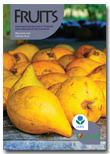
Fruit characterization of Pouteria campechiana ([Kunth] Baehni) in three different stages of maturity
S. Evangelista-Lozano1,a, H.R. Robles-Jímarez1, J.F. Pérez-Barcena1, E. Agama-Acevedo1, R. Briones-Martínez1 and J.G. Cruz-Castillo2
1 Instituto Politécnico Nacional, Centro de Desarrollo de Productos Bióticos (CEPROBI-IPN), Carretera Yautepec-Jojutla, Km 6, Calle CEPROBI No. 8, Col. San Isidro, C.P. 62731, Yautepec, Morelos, Mexico
2 Centro Regional Universitario Oriente, Universidad Autónoma Chapingo, C.P. 94100, Huatusco, Veracruz, Mexico
|
SUMMARY
Introduction – Pouteria campechiana is a little-studied Sapotaceae from Mexico. It is distributed in evergreen forests and is appreciated for the hardness of its wood and the nutritional content of its fruit. Objective – To evaluate the physical and chemical composition of the peel, pulp, and seed of P. campechiana at harvest, maturity, and consumption. Materials and methods – Fruits were harvested at different stages of maturity, as defined by peel color (green, green-yellow, and yellow). The fruits were collected and characterized physically and chemically. Proximate analysis was performed on the peel, pulp, and seed, and carotenoids were identified in the peel and pulp by HPLC-MS. Results and discussion – In fruits with peel color ranging from green to yellow, the firmness and titratable acidity decreased from 2.6 to 0.8 N and from 0.4 to 0.1%, respectively, but the TSS (total soluble solids) increased from 12 to 34 °Brix. The proximal chemical analysis of the peel was: ash 2.8%, protein 8.9%, fiber 17.3%, and lipids 10.7%. The pulp was high in nitrogen-free extract, the protein content of peel and pulp showed different values, and the lipid content was higher in the peel than in the pulp. The seed presented 1–1.7% lipids, 20–39% total carbohydrates, and 5–10% proteins. The peel had the highest xanthophyll content. The β-carotene in pulp increased as fruits matured from green to green-yellow and decreased as they progressed to yellow. Lutein was detected only in green-yellow fruits. Conclusion – Carbohydrates, fiber, carotenoids, TSS, and the yellow color of the fruit were indicators of maturity for consumption; the best time for harvest was the green-yellow stage. Keywords canistel, carotenoids, harvest maturity, neglected Mesoamerican fruits, tropical fruit
|
Significance of this study
What is already known on this subject?
|

|


|
E-mail: sevangel@ipn.mx
References
AACC. (2000). Approved Methods of the American Association of Cereal Chemists, 32-06.01 (Washington D.C., U.S.A.)
Alia-Tejacal, I., Villanueva-Arce, R., Pelayo-Zaldívar, C., Colinas, M.T., López, V., and Bautista-Baños, S. (2007). Postharvest physiology and technology of sapote mamey fruit (Pouteria sapota (Jacq.) H.E. Moore & Stearn). Postharvest Biol. Technol. 45(3), 285–297. https://doi.org/10.1016/j.postharvbio.2006.12.024.
Almeyda, N., and Martin, F.W. (1976). Cultivation of neglected tropical fruit with promise. Part 2, Mamey zapote. USDA, ARS Techn. Bull. 156, 113.
AOAC. (2005). Official Method of Analysis, 18th edn. Method 935.14 and 992.24 (Washington D.C.: Association of Officiating Analytical Chemists), https://www.aoac.org/AOAC_Prod_Imis/AOAC_Member/Default.aspx?WebsiteKey=2e25ab5a-16d-4d78-a498-19b9763d11b4&hkey=8fc2171a-6051-4e64-a928-5c47dfa25797.
Arenas-Ocampo, M.L., Evangelista-Lozano, S., Arana-Errasquin, R., Jiménez-Aparicio, A.R., and Dávila-Ortíz, G. (2003). Softening and biochemical changes of zapote mamey fruit (Pouteria sapota) at different development and ripening stages. J. Food Biochem. 27, 9–107. https://doi.org/10.1111/j.1745-4514.2003.tb00269.x.
Aseervatham, G., Manthra, S.B., Ireen, V., Thilagameena, C., Akshaya, S., Clara, M.S., and Sivasudha, A.T. (2019). Free radical scavenging potential and antihaemolytic activity of methanolic extract of Pouteria campechiana (Kunth) Baehni. and Tricosanthes tricuspidata Linn. Biocatalysis and Agric. Biotechn. 18, 101031. https://doi.org/10.1016/j.bcab.2019.101031.
Atapattu, N.S.B.M., and Mendis, A.P.S. (2013). Evaluation of Canistel (Pouteria campechiana) fruit meal as feed ingredient for poultry. Iranian J. Appl. Animal Sci. 3(1), 177–183.
Awang-Kanak, F., and Bakar, M.F.A. (2018). Canistel – Pouteria campechiana (Kunth) Baehni. In Exotic Fruits, S. Rodrigues, E. de Oliveira, and E. Sousa, eds. (Cambridge, Mass., U.S.A.: Academic Press), p. 107–111. https://doi.org/10.1016/B978-0-12-803138-4.00015-0.
Azurdia, C. (2006). Tres especies de zapote en América tropical (Southampton, U.K.: Southampton Centre for Underutilised Crops, University of Southampton), ISBN: 0854328432.
Buchanan, B.B., Gruissem, W., and Jones, R.L. (2000). Membrane structure and inheritance of cell membranes. In Biochemistry Molecular Biology of Plants (Rockville, Md., U.S.A.: American Society of Plant Physiologists).
Cabra, V., Arreguín, R., and Farres, A. (2008). Emulsifying properties of proteins. Boletín de La Sociedad Química de México 2(2), 80–89. https://doi.org/10.1007/978-3-642-59116-7_4.
Cantwell, M.I., and Reid, M.S. (1993). Postharvest physiology and handling of fresh culinary herbs. J. Herbs Spices Med. Plants 1, 93–127. https://doi.org/10.1300/J044v01n03_09.
Cordeiro, N., Sousa, L., Freitas, N., and Gouveia, M. (2013). Changes in the mesocarp of Annona cherimola Mill. ‘Madeira’ during postharvest ripening. Postharvest Biol. Technol. 85, 179–184. https://doi.org/10.1016/j.postharvbio.2013.05.014.
Costa, T. da S.A., Wondracek, D.C., Lopes, R.M., Vieira, R.F., and Ferreira, F.R. (2010). Composição de carotenoides em canistel (Pouteria campechiana (Kunth) Baehni). Rev. Bras. Frutic. 32(3), 903–906. https://doi.org/10.1590/S0100-29452010005000083.
Crane, J.H., and Balerdi, C.F. (2019). Canistel growing in the Florida home landscape. (U.S.A.: UF/IFAS Extension), 6 pp. https://edis.ifas.ufl.edu/pdffiles/HS/HS29900.pdf.
Dáger, B., Cornejo, P., Demerutis, C., and Palacios, R. (2007). Determinación del estado de madurez óptimo para cosecha y caracterización de Pouteria campechiana Kunth. Tierra Tropical 3(1), 109–116.
De Lanerolle, M., Priyadarshani, A.M., Sumithraarachchi, D.B., and Jansz, E.R. (2008). The carotenoids of Pouteria campechiana (Sinhala: ratalawulu). J. Nat. Sci. Found. Sri Lanka 36(1), 95–98. https://doi.org/10.4038/jnsfsr.v36i1.136.
Dubois, M., Gilles, K.A., Hamilton, J.K., Rebers, P.A., and Smith, F. (1956). Colorimetric method for determination of sugars and related substances. Anal. Chem. 28(3), 350–356. https://pubs.acs.org/doi/pdf/10.1021/ac60111a017#.
Eskin, N.A.M., and Hoehn, E. (2013). Chapter 2 - Fruits and Vegetables. In Biochemistry of Foods, 3rd edn. (San Diego: Academic Press), p. 49–126. https://doi.org/10.1016/B978-0-08-091809-9.00002-9.
Henríquez, J.M. (1973). Patrones de respiración de algunas frutas tropicales. Proc. Trop. Region. Am. Soc. Hortic. Sci. 17, 167–175.
Ho, B.T., Hofman, P.J., Joyce, D.C., and Bhandari, B.R. (2016). Uses of an innovative ethylene-α-cyclodextrin inclusion complex powder for ripening of mango fruit. Postharvest Biol. Technol. 113, 77–86. https://doi.org/10.1016/j.postharvbio.2015.11.005.
Ibarra, G.I.P., Ramos, P.P.A., Hernández, B.C., and Jacobo, V.D.A. (2015). Effects of postharvest ripening on the nutraceutical and physicochemical properties of mango (Mangifera indica L. cv. Keitt). Postharvest Biol. Technol. 103, 45–54. https://doi.org/10.1016/j.postharvbio.2015.02.014.
Khoo, H.E., Prasad, K.N., Kong, K.W., Jiang, Y., and Ismail, A. (2011). Carotenoids and their isomers: Color pigments in fruits and vegetables. Molecules 16, 1710–1738. https://doi.org/10.3390/molecules16021710.
Krinsky, N.I. (1994). The biological properties of carotenoids. Pure and Appl. Chem. 66(5), 1003–1010. https://doi.org/10.1351/pac199466051003.
Kubola, J., Siriamornpun, S., and Meeso, N. (2011). Phytochemicals, vitamin C and sugar content of Thai wild fruits. Food Chem. 126(3), 972–981. https://doi.org/10.1016/j.foodchem.2010.11.104.
McGuire, R.G. (1992). Reporting of objective color measurements. Hortscience 27(12), 1254–1255. https://doi.org/10.21273/HORTSCI.27.12.1254.
Morton, J. (1987). Canistel. In Fruits of Warm Climates (Miami: J.F. Morton), p. 402–405. https://www.hort.purdue.edu/newcrop/morton/index.html.
Nath, P., Bouzayen, M., Mattoo, A.K., and Pech, J.C. (2014). Fruit Ripening: Physiology, Signalling and Genomics. CABI. https://doi.org/10.1079/9781845939625.0000.
Nhung, D.T.T., Bung, P.N., Ha, N.T., and Phong, T.K. (2010). Changes in lycopene and beta carotene contents in aril and oil of gac fruit during storage. Food Chem. 121, 326–331 https://doi.org/10.1016/j.foodchem.2009.12.032.
NMX-F-102-S-1978. (1978). Determinación de la acidez titulable en productos elaborados a partir de frutas y hortalizas. https://www.colpos.mx/bancodenormas/nmexicanas/NMX-F-102-S-1978.PDF.
Orwa, C., Mutua, A., Kindt, R., Jamnadass, R., and Anthony, S. (2009). Agroforestree Database: A Tree Reference and Selection Guide, v. 4.0 (Kenya: World Agroforestry Centre).
Pennington, T.D., and Sarukhán, J. (2016). Arboles tropicales de México. Manual para la identificación de las principales especies (Ciudad de México, México: Dirección General de Publicaciones y Fomento Editorial, Universidad Autónoma de México), pp. 438. ISBN/ISSN 9789703216437.
Prasanna, V., Prabha, T.N., and Tharanathan, R.N. (2010). Fruit ripening phenomena – An overview. Critical Rev. Food Sci. Nutr. 47(1), 1–19. https://doi.org/10.1080/10408390600976841.
Pushpakumara, D.K.N.G. (2007). Ch. 16: Lavulu Pouteria campechiana Kunth Baehni. In Underutilized Fruit Trees in Sri Lanka, D.K.N.G. Pushpakumara, H.P.M. Gunasena, and H.V.P. Sing, eds. (New Delhi, India: World Agroforestry Centre, South Asia Office), p. 426–436.
Razungles, A.J., Babic, I., Sapis, J.C., and Bayonove, C.L. (1996). Particular behavior of epoxy xanthophylls during veraison and maturation of grape. J. Agric. Food Chem. 44(12), 3821–3825. https://doi.org/10.1021/jf960260t.
Reid, M.S. (2002). Maturation and maturity indices. In Postharvest Technology of Horticultural Crops, 3rd edn., Agricultural and Natural Resources, Publication 3311, A.A. Kader, ed. (Oakland, California: University of California), p. 55–62.
Rienzo, J.A., Casanoves, F., Balzarini, M.G., Gonzalez, L., and Tablada, M. (2018). InfoStat. Argentina, FCA, Grupo InfoStat, Universidad Nacional de Córdoba https://www.infostat.com.ar/index.php?mod=page&id=34 (accessed August 2019).
Saltveit, M.E. (1999). Effect of ethylene on quality of fresh fruits and vegetables. Postharvest Biol. Technol. 15, 279–292 https://doi.org/10.1016/S0925-5214(98)00091-X.
Sauls, J.W., Campbell, C.W., Balerdi, C.F., and Crane, J.H. (2018). El Canistel en Florida. Horticultural Sciences, HS1043, (Universidad de la Florida: Servicio de Extensión Cooperativa de la Florida, Instituto de Alimentos y Ciencias Agrícolas, UF/IFAS). http://edis.ifas.ufledu.
Solis, F.J.A., Tapia, S.M., and Duran, M. (2001). Oil from the zapote mamey almond, and analysis of its extraction conditions and yields. Información Tecnológica 12(6), 23–28.
Solovchenko, A., Yahia, E.M., and Chen, C. (2019). Chapter 11 – Pigments. In Postharvest Physiology and Biochemistry of Fruits and Vegetables, E.M. Yahia, ed. (Woodhead Publishing), p. 225–252. ISBN 9780128132784, https://doi.org/10.1016/B978-0-12-813278-4.00011-7.
Torres, R., Montes, E.J., Pérez, O.A., and Andrade, R.D. (2013). Relación del color y del estado de madurez con las propiedades fisicoquímicas de frutas tropicales. Información Tecnológica 24(3), 51–56. https://doi.org/10.4067/S0718-07642013000300007.
Turcsi, E., Nagy, V., and Deli, J. (2016). Study on the elution order of carotenoids on endcapped C18 and C30 reverse silica stationary phases. A review of the database. Subtropical Plant Sci. 47, 101–112. https://doi.org/10.1016/j.jfca.2016.01.005.
Villanueva, A.R., Evangelista, L.S., Arenas, O.M.L., Díaz, P.J.C., and Bautista, B.S. (2000). Cambios bioquímicos y físicos durante el desarrollo y postcosecha del mamey (Pouteria sapota (Jacq.) H.E. Moore y Stearn). Rev. Chapingo Serie Hort. 6(1), 63–72. https://doi.org/10.5154/r.rchsh.1998.10.070.
Wills, R., McGlasson, W., Graham, D., and Joyce, D. (1998). Postharvest: An Introduction to the Physiology and Handling of Fruit Vegetables and Ornamentals, 4th edn. (Adelaide, SA, Australia: Hyde Park Press). https://doi.org/10.1079/9781786391483.0000.
Yahia, E.M. (2019). Chapter 1 – Introduction. In Postharvest Physiology and Biochemistry of Fruits and Vegetables, E.M. Yahia, ed. (Woodhead Publishing), p. 1–17. ISBN 9780128132784. https://doi.org/10.1016/B978-0-12-813278-4.00001-4.
Received: 11 June 2020 | Accepted: 7 December 2020 | Published: 25 May 2021 | Available online: 25 May 2021


