

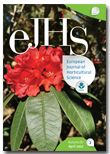
ISSN 1611-4426 print and 1611-4434 online | © ISHS 2022 | European Journal of Horticultural Science | Original article
Analysis of quality-related nonvolatile metabolites in tea (Camellia sinensis) resources with different shoot colors
Zhihui Wang1,2, Puxiang Yang1,2, Hua Peng1,2, Wenjin Li1,2, Cuinan Yue1,2 and Chen Li1,2
1 Jiangxi Sericulture and Tea Research Institute, Nanchang, China
2 Jiangxi Key Laboratory of Tea Quality and Safety Control, Nanchang, China
|
SUMMARY
The shoot color of tea resources are various, such as green, purple and yellow, however, the differences in their main nonvolatile metabolites and quality of tea had not been clarified. In this study, 21 nonvolatile metabolites of 15 tea resources with three different shoot colors were analyzed. Our results showed that the coefficient of variation of 21 nonvolatile metabolites of tea resources was yellow shoots (23.83%) > green shoots (20.95%) > purple shoots (20.18%). The contents of water extract, tea polyphenols, total catechins, anthocyanins and flavonoids in purple shoots were significantly higher than those in green and yellow shoots; the contents of free amino acids in yellow shoots were significantly higher than those in purple and green shoots, the contents of chlorophyll and carotenoids in yellow shoots were significantly lower than purple and green shoots (P<0.05); the contents of most metabolites in green shoots were between purple and green shoots. Yellow shoots and green shoots were suitable for producing high quality green tea, while purple shoots were poor. PLS-VIP analysis showed that there were differences in quality-related key nonvolatile metabolites among three kinds of tea resources. Finally, seven different metabolites including free amino acids, anthocyanins, chlorophyll a, chlorophyll b, carotenoids, non-ester catechins and flavonoids were used to establish an effective classification method for three kinds of shoot color tea resources. The results provided a basis for us to understand the quality-related nonvolatile metabolites of tea resources with different bud and leaf colors. Keywords classification, nonvolatile metabolites, shoot color, tea plant, tea resources |
Significance of this study
What is already known on this subject?
|

|


|
E-mail: jxypx@163.com
References
Bao, Y.X., Xia, L.F., Li, Y.Y., and Liang, M.Z. (2008). A new tea tree cultivar ‘Zijuan’. Acta Hortic. Sinica 35, 934–934.
Chen, J.D., Ma, C.L., and Chen, L. (2019). 40 years of research on tea germplasm resources in China. China Tea 41, 4–8.
Chen, L., Yang, Y.J., and Yu, F.L. (2005). Descriptors and Data Standard for Tea (Camellia spp.) (Beijing, China: China Agriculture Press).
Chen, Q., and Yang, Y.J. (2011). Anti-inflammatory effects of purple tea leaves. Anhui Med. Pharmaceut. J. 15, 676–678.
Chen, Q.C., Zhu, Y., Dai, W.D., Lv, H.P., Mu, B., Li, P.L., Tan, J.F., Ni, D.J., and Lin, Z. (2019). Aroma formation and dynamic changes during white tea processing. Food Chem. 274, 915–924. https://doi.org/10.1016/j.foodchem.2018.09.072.
Dai, Z.Y., Huang, H.L., Zhang, Q.J., Bei, J.L., Chen, Z.J., Liu, Q.J., Gao, J.D., Zhang, S., and Liu, J. (2021). Comparative multi-omics of tender shoots from a novel ever growing tea cultivar provide insight into winter adaptation mechanism. Plant Cell Physiol. 62, 366–377. https://doi.org/10.1093/pcp/pcaa167.
GB/T. (2013a). Tea-Determination of free amino acids content (Standardization Administration of the People’s Republic of China).
GB/T. (2013b). Tea-Determination of water extracts content (Standardization Administration of the People’s Republic of China).
GB/T. (2018a). Determination of total polyphenols and catechins in tea (Standardization Administration of the People’s Republic of China).
GB/T. (2018b). Methodology for sensory evaluation of tea. (Standardization Administration of the People’s Republic of China).
Graham, H.N. (1992). Green tea composition, consumption, and polyphenol chemistry. Prevent. Med. 21, 334–350.
Guo, X.Y., Ho, C.T., Schwab, W., and Wan, X.C. (2021). Effect of the roasting degree on flavor quality of large-leaf yellow tea. Food Chem. 347, 129016. https://doi.org/10.1016/j.foodchem.2021.129016.
Huang, K.Y., Li, M., Liu, Y.J., Zhu, M.Q., Zhao, G.F., Zhou, Y.H., Zhang, L.J., Wu, Y.L., Dai, X.L., Xia, T., and Gao, L.P. (2019). Functional analysis of 3-dehydroquinate dehydratase/shikimate dehydrogenases involved in shikimate pathway in Camellia sinensis. Frontiers Plant Sci. 10, 1268. https://doi.org/10.3389/fpls.2019.01268.
Huang, Y.N., Qiu, L., Mi, X., Zhang, Z.H., Xu, D., Tao, X.Y., Xing, K.Y., Wu, Q.L., and Wei, H. (2020). Hot-water extract of ripened Pu-erh tea attenuates DSS-induced colitis through modulation of the NF-?B and HIF-1a signaling pathways in mice. Food & Function 11, 3459–3470. https://doi.org/10.1039/C9FO02803J.
Katsuno, T., Kasuga, H., Kusano, Y., Yaguchi, Y., Tomomura, M., Cui, J.L., Yang, Z.Y., Baldermann, S., Nakamura, Y., Ohnishi, T., Mase, N., and Watanabe, N. (2014). Characterisation of odorant compounds and their biochemical formation in green tea with a low temperature storage process. Food Chem. 148, 388–395. https://doi.org/10.1016/j.foodchem.2013.10.069.
Liao, Y.Y., Yu, Z.M., Liu, X.Y., Zeng, L.T., Cheng, S.H., Li, J.L., Tang, J.C., and Yang, Z.Y. (2019). Effect of major tea insect attack on the formation of quality-related non-volatile specialized metabolites in tea (Camellia sinensis) leaves. J. Agric. Food Chem. 67(24), 6716–6724. https://doi.org/10.1021/acs.jafc.9b01854.
Liu, F.Z., Huang, J.A., Fu, D.H., He, D.Q., and Chang, J.L. (2020). Biochemical properties of new shoots of tea trees. J. Hunan Agric. Univ. 26(1), 41–42.
Maritim, T.K., Masand, M., Seth, R., and Sharma, R.K. (2021). Transcriptional analysis reveals key insights into seasonal induced anthocyanin degradation and leaf color transition in purple tea (Camellia sinensis (L.) O. Kuntze). Sci. Rep. 11, 1244. https://doi.org/10.1038/s41598-020-80437-4.
Mei, Y., Xie, H., Liu, S., Zhu, J.Y., Zhao, S.Q., and Wei, C.L. (2020). Metabolites and transcriptional profiling analysis reveal the molecular mechanisms of the anthocyanin metabolism in the ‘Zijuan’ tea plant (Camellia sinensis var. assamica). J. Agric. Food Chem. 69(1), 414–427. https://doi.org/10.1021/acs.jafc.0c06439.
Qin, D.D., Wang, Q.S., Li, H.J., Jiang, X.H., Fang, K.X., Wang, Q., Li, B., Pan, C.D., and Wu, H.L. (2020). Identification of key metabolites based on non-targeted metabolomics and chemometrics analyses provides insights into bitterness in Kucha [Camellia kucha (Chang et Wang) Chang]. Food Res. Intl. 138, 109789. https://doi.org/10.1016/j.foodres.2020.109789.
Rashid, K., Wachira, F.N., Nyabuga, J.N., Wanyonyi, B., Murilla, G., and Isaac, A.O. (2013). Kenyan purple tea anthocyanins ability to cross the blood brain barrier and reinforce brain antioxidant capacity in mice. Nutr. Neurosci. 17(4), 178–185. https://doi.org/10.1179/1476830513Y.0000000081.
Wan, X.C., and Xia, T. (2015). Secondary Metabolism of Tea Plant, 1st edn. (Beijing, China: Science Press) (in Chinese).
Wang, L., Yue, C., Cao, H., Zhou, Y.H., Zeng, J.M., Yang, Y.J., and Wang, X.C. (2014). Biochemical and transcriptome analyses of a novel chlorophyll-deficient chlorina tea plant cultivar. BMC Plant Biol. 14(1), 352. https://doi.org/10.1186/s12870-014-0352-x.
Wang, L.Y., Zhao, R.B., Cheng, H., Wei, K., Ruan, L., and Wu, L.B. (2020). Current situation on breeding of tea cultivars with special leaf colors. China Tea 42(1), 15–19.
Wang, Z.H. (2016). Analysis on biochemical components of Fuchsia tea leaves in Yunnan Menghai and spring shoots of Zijuan tea. Food Sci. Technol. 41(6), 51–55.
Wang, Z.H., Peng, H., Jiang, X.F., and Yang, P.X. (2020a). Analysis on the phenotypic diversity of buds and leaves of tea germplasm resources in Jiangxi Province. Jiangsu Agric. Sci. 48, 134–142.
Wang, Z.H., Yue, C.N., Li, C., Cai, H.L., Peng, H., Li, W.J., Hu, Y.G., and Yang, P.X. (2020b). Diversity analysis and evaluation of chemical characteristics of tea germplasms in Jiangxi province. Jiangsu J. Agric. Sci. 36(1), 172–179.
Wang, Z.H., Yue, C.N., and Tong, H.R. (2021). Analysis of taste characteristics and identification of key chemical components of fifteen Chinese yellow tea samples. J. Food Sci. Technol. – Mysore 58, 1378–1388. https://doi.org/10.1007/s13197-020-04649-2.
Wei, K., Zhang, Y.Z., Wu, L.Y., Li, H.L., Ruan, L., Bai, P.X., Zhang, C.C., Zhang, F., Xu, L.Y., Wang, L.Y., and Cheng, H. (2016). Gene expression analysis of bud and leaf color in tea. Plant Physiol. Biochem. 107, 310–318. https://doi.org/10.1016/j.plaphy.2016.06.022.
Wu, H.L., He, Y.M., Li, J.X., Chen, D., Huang, H.L., Qiao, X.Y., and Liu, J. (2012). Shoot traits and biological copositions among eleven new tea germplasms with reddishviolet shoots. J. Plant Gen. Res. 13(1), 42–47.
Xu, Y.X., Shen, C.J., Ma, J.Q., Chen, W., Mao, J., Zhou, Y.Y., and Chen, L. (2017). Quantitative succinyl-proteome profiling of Camellia sinensis cv. ‘Anji Baicha’ during periodic albinism. Sci. Rep. 7(1), 1873. https://doi.org/10.1038/s41598-017-02128-x.
Yang, R.X., Kong, X.R., Zhang, L., Chen, Z.Z., and You, Z.M. (2016). Numerical taxonomy of leaf color phenotypes for tea (Camellia sinensis). Acta Trop. Subtrop. Flora 24(4), 444–451.
Yang, X.R., Bao, Y.X., and Huang, M. (2009). Botanical and quality characteristics of a rare tea variety ‘Zijuan’ in Yunnan. Tea 35(1), 17–18.
Yao, M.Z., Ma, C.L., Qiao, T.T., Jin, J.Q., and Cheng, L. (2012). Diversity distribution and population structure of tea germplasms in China revealed by EST-SSR markers. Tree Genetics Genomes 8(1), 205–220. https://doi.org/10.1007/s11295-011-0433-z.
Ye, Y.L., Yan, J.N., Cui, J.L., Mao, S.H., Li, M.F., Liao, X.L., and Tong, H.R. (2017). Dynamic changes in amino acids, catechins, caffeine and gallic acid in green tea during withering. J. Food Comp. Anal. 66, 98–108. https://doi.org/10.1016/j.jfca.2017.12.008.
Yu, Z.M., and Yang, Z.Y. (2020) Understanding different regulatory mechanisms of proteinaceous and non-proteinaceous amino acid formation in tea (Camellia sinensis) provides new insights into the safe and effective alteration of tea flavor and function. Critical Rev. Food Sci. Nutr. 60(5), 844–858. https://doi.org/10.1080/10408398.2018.1552245.
Yue, C.N. (2017). Establishment of Reference Material Model of Green Tea Based on its Taste Material Research (Chongqing, China: Southwest Univ.).
Yue, C.N., Wang, Z.H., Mao, S.H., Li, X.Y., and Tong, H.R. (2017). The main taste substances in tea research progress. Food Res. Developm. 38(1), 219–224.
Yue, C.N., Wang, Z.H., Shi, X.P., Jiang, X.F., Li, Y.S., and Yang, P.X. (2020). Effects of light quality on aroma metabolites in tea: A review of recent literature. Food Sci. 41(5), 299–305.
Zhou, B.X., Ma, C.Q., Ren, X.Y., Xia, T., and Li, X.H. (2020). LC–MS/MS based metabolomic analysis of caffeine regrading fungus Aspergillus sydowii during tea fermentation. J. Food Sci. 85(2), 477–485. https://doi.org/10.1111/1750-3841.15015.
Zhou, Q.Q., and Sun, W.J. (2015). Physiological and biochemical analysis of young shoot purple-related and gene expression of key enzymes in tea plant (Camellia sinensis). Biotechnol. Bull. 1, 1–7.
Zhu, S.D., Chen, L., Jiao, J., Li, C.Z., Liu, W.L., and Zhao, Y. (2019). Effects of soil drought and grass intercropping on photosynthetic characteristics of olive. Jiangsu J. Agric. Sci. 35(2), 282–288.
Received: 25 February 2021 | Accepted: 8 August 2021 | Published: 19 April 2022 | Available online: 19 April 2020


