|
|
|
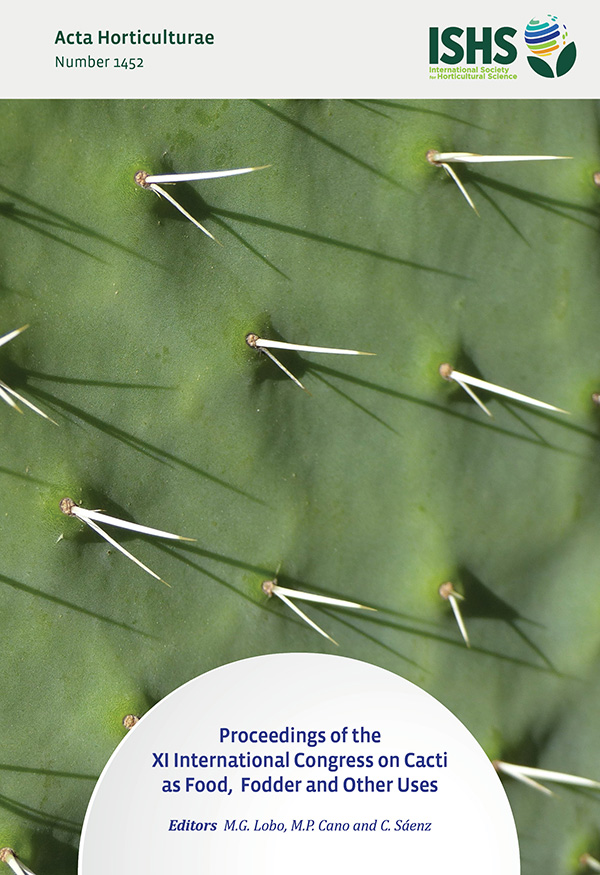
ISHS Acta Horticulturae 1452XI International Congress on Cacti as Food, Fodder and Other Uses |
| List price | € 113 Buy this book
This title is only available in e-Acta format - not available in print |
| Conveners | M.P. Cano, M.G. Lobo, D. Ríos Mesa |
| Editors | M.G. Lobo, M.P. Cano, C. Sáenz |
Publication
date | 10 April 2026 |
| ISBN | 978-94-62614-52-9 |
| ISSN | 2406-6168 (electronic) |
| Number of articles | 65 |
| Place | Adeje, Tenerife, Canary Islands, Spain |
| Online articles: |
 | Acta Horticulturae 1452 - cover - colophon - contents - authors |
 | Cacti: fundamentals, facts, food and fodder for future farming (M. de Wit) |
| New perspectives on cactus pear fruit production and postharvest management (G. Liguori, G. Greco, P. Inglese) |
| Soil quality assessment for sustainable cultivation of Opuntia ficus-indica in Kutch (India): identifying key edaphic factors (M. Louhaichi, A. Naorem, S. Hassan) |
| Flowering and fruiting of pitaya (S. undatus): insights into reproductive processes and farming potential for the Algarve, Portugal (A.R. Trindade, P. Matias, B. Duarte, D. Trindade, A. Duarte) |
| First phenological and productive observations of pitaya (Hylocereus undatus) in an unheated greenhouse in Italy (F.G. Casales, A. Allegra, G. Sortino, V. Farina, P. Inglese, I. Tinebra) |
| Production behaviour of pitahaya depending on the trellising system used (S. Valle, V. Raya) |
| Opuntia ficus-indica chronosequence affects soil carbon mineralization rates (G. Greco, G. Liguori, F. Gargano, P. Inglese, C. Souza de Sousa, M. Ruiz Moreno, J.C.B. Dubeux) |
| Integrating spineless cactus cultivation with regenerative agriculture: a synergistic approach to enhance climate-resilient feedstock production and wildlife conservation in Africa (A. Tarrisse, S. Pilafidis, M. de Wit) |
| Opuntia ficus-indica mucilage-based edible coating: a sustainable potential solution to preserve lemon fruits during cold storage (F. Gargano, G. Greco, R. Gaglio, L. Settanni, P. Inglese, G. Liguori) |
| Dragon fruit cacti: potential in the Virgin Islands (R. Smart, T.W. Zimmerman) |
| Distribution and diversity of the genus Opuntia in Spain: opportunities for sustainable agricultural production in the context of climate change (J.I. Hormaza, N. Larrañaga) |
| Improving cactus pear production: a case study of intensive cultivation practices in Italy (P. Inglese, G. Liguori, F. Gargano, G. Greco, S. Moradi) |
| Gravel culture of the edible cactus Nopalea cochenillifera: effect of fertilizer composition on daughter cladode growth and mineral content (T. Horibe, S. Tsuchimoto) |
| Influence of organic and inorganic fertilization on the yield and quality of cactus pear (Opuntia ficus-indica) fruit (S. Cloete, M. de Wit, G.M. Coetzer) |
| Modified atmosphere packaging of cactus pear: a mini review (S. D’Aquino, A. Palma) |
| Cactus pears postharvest disorders and quality as affected by storage temperature (S. D’Aquino, A. Palma) |
| Assessing water requirements of pitaya (S. undatus) under greenhouse conditions: a first step towards optimizing irrigation (A.R. Trindade, E. Veiga, A. Arozarena, M.A. Neves, A. Duarte) |
| Optimization of in vitro germination and callogenesis in Opuntia ficus-indica for biotechnological applications (O. Bouihate, I. Touaf, I. Bachti, R. El Boullani, K. Lagram, M.A. Serghini, A. El Mousadik, A. El Finti) |
| Proteomic analysis of nitrogen fertilization effects on Opuntia ficus-indica mucilage using modified TCA/acetone precipitation (V. Nkoi, M. de Wit, A. van Biljon, J. van Niekerk) |
| Chemical and physical characterization of white and pinkish-red pitaya fruits cultivated in Mediterranean greenhouses: a first study in Sicily, Italy (A. Allegra, E. Sultano, G. Gentile, F.G. Casales, A. Angelo, E. Guccione, G. Sortino) |
| Sampling procedures to determine fruit size in pitaya (R. Rodríguez-Garrido, A.P.M. Carmo, F.M. Chiamolera, I. Salinas, J. Cuevas) |
| Development of predictive models for fruit quality with portable NIR spectroscopy evaluation in pitaya produced in Mediterranean greenhouses (I. Portillo, I. Salinas, V. Pinillos) |
| Water requirements of pitahaya in subtropical climates (S. Valle, V. Raya) |
| Postharvest conservation conditions (temperature, relative humidity, packaging, and treatment) to ensure the quality of pitahaya (I. Díaz-Marrero, G.L. Díaz-Delgado, E. Dorta, C. Méndez-Hernández, C. Fernández Casanova, M.P. Cano, M.G. Lobo) |
| Pitaya cultivation in greenhouse in hydroponic system (NGS) in the south of Spain (J.J. Hueso, A. Oliva) |
| Enhancing propagation techniques for prickly pear (Opuntia ficus-indica L.): evaluation of seed germination and cladode rooting (I. Touaf, O. Bouihate, I. Bachti, R. Idaoud, I. Boudadi, K. Lagram, M.A. Serghini, A. El Mousadik, A. El Finti, R. El Boullani) |
| Effects of planting density and soil management on pitaya (S. undatus) yield in an outdoor plantation (A.R. Trindade, P. Matias, B. Duarte, D. Trindade, A. Duarte) |
| Cactus pear germplasm conservation and characterization in Canary Islands (M.J. Grajal-Martín, A. Peña Dorta, M.Y. González Padrón, S. García Medina, J. Cabrera Cabrera, J. Monagas Rodríguez) |
| Dragon fruit: morphological and molecular characterization (C. Méndez Hernández, A. Coello Torres, M.Y. González Padrón, M.J. Grajal-Martín) |
| Actions protocol to face cactus cochineal in non-native regions (L. Portillo) |
| Morphological characterization of Dactylopius opuntiae (Cockerell) present in Morocco using scanning electron microscopy (A. El Finti, I. Touaf, O. Bouihate, I. Bachti, R. Ezzahiri, K. Lagram, M.A. Serghini, A. El Mousadik, R. El Boullani) |
| Conception and validation of three schematic logarithmic scales to quantify damage of Dactylopius opuntiae (Cockerell, 1929) (Hemiptera: Dactylopiidae), and development of OpiShield mobile application that helps evaluate this damage on the basis of the three logarithmic scales (A. Azzouzi, H. Anejjar, A. Id-M’hamed, A. Ait Said, R. Lahlali, M. Ait Chitt, A. Boutaleb Joutei, T. Benziane) |
| Identification of the phytochemical compounds in the crude extract of cactus pear (Opuntia ficus-indica) fruit (L.K. Mamabolo, G.M. Coetzer, E. Van der Watt, H.A. Njom) |
| Cactus pear and other cacti: processed foods for the climate change (C. Sáenz) |
| Consumer acceptability of cold-pressed cactus pear seed oils (Opuntia ficus-indica and Opuntia robusta) in comparison to other cold-pressed common functional vegetable oils and their formulated cosmetic emulsion creams (K. Nematshema, M. de Wit, A. Hugo, J. van Niekerk, B. van Rooyen) |
| Oven drying as a preservative process of two cultivars of cactus pear fruits (Opuntia ficus-indica) (G. Semedo, C. Rodrigues, A.L. Fernando, V.G.L. Souza) |
| Role of prickly pear (Opuntia ficus-indica) fruit in enhancing the quality of life of women with fibromyalgia syndrome – a preliminary investigation (S. Sberro-Cohen, N. Tel-Zur, E. Keren, J. Grinshpun, L. Zeller, O. Sarid, O. Grinstein-Cohen) |
| Development of a new product based on cactus pear (V.G.L. Souza, C. Rodrigues, E. Macedo, A.L. Fernando) |
| Rheological properties of cosmetic emulsion creams containing cold-pressed cactus pear seed oils (Opuntia ficus-indica and Opuntia robusta) compared to other cold-pressed common functional vegetable oils (K. Nematshema, M. de Wit, A. Hugo, J. van Niekerk, B. van Rooyen) |
| Liqueurs from coloured cactus pear using low-calorie sweeteners as sugar replacements (C. Sáenz, M.C. Arellano, E. Loyola, M. Medel) |
| Development, physico-chemical and sensory analysis of cactus pear (Opuntia ficus-indica) muesli (S. Cloete, M. de Wit, A. du Toit) |
| Microscopic differences observed in Opuntia ficus-indica ‘Algerian’ and ‘Turpin’ during postharvest refrigerated storage – Part 1 (J.A. Viktor, M. de Wit, A. du Toit, G. Osthoff) |
| The big picture of the small picture: examining the mucilage of Opuntia ficus-indica ‘Algerian’ and Opuntia robusta for the effects of postharvest refrigeration – Part 2 (J.A. Viktor, M. de Wit, A. du Toit, G. Osthoff) |
| Evaluating the barrier properties and potential applications of cactus pear mucilage-based films in comparison to pectin, alginate, and gellan gum-based films (V. Nkoi, N. Zondo, B. van Rooyen, M. de Wit, A. Hugo) |
| Cactus pear baked cracker snacks: sensory analysis of crackers made with liquid nopalitos pulp and dried nopalitos powder (I. Tom, C. Bothma, A. du Toit, M. de Wit) |
| Desert treasure: revealing secrets and health benefits of cacti and prickly pear (M. Antunes-Ricardo) |
| Characterization of mucilage from Opuntia ficus-indica grown wild in Apulia (southern Italy) (F. Blando, F. Iaconeta, F. Milano, L. Giotta) |
| Development of antioxidant gelatin films using corn and nopal-derived biopolymers for potential topical treatments (L.V. Bonifaz Delgado, D.E. Mejía Valdez, D. Guajardo Flores) |
| Tailored biopolymeric scaffolds from Opuntia ficus-indica for chronic wound healing using a hybrid manufacturing approach (J. Vazquez-Armendariz, M. Martínez-Ávila, M. Antunes-Ricardo, R. Tejeda-Alejandre, V. Segura-Ibarra, D. Dean, C.A. Rodriguez-Gonzalez) |
| Encapsulation of Opuntia extracts for improved delivery and bioaccessibility of their antioxidant bioactives (S. Parralejo-Sanz, M.G. Lobo, T. Requena, M.P. Cano) |
| Ultrasound-assisted “Green” extraction improves phenolic content and antioxidant activity of the peel, pulp, and seeds of Brazilian cactus fruit (Cereus sp.) (E. dos Santos, B.S. Martines Batista, N. Marques da Silva, R. Guttierres Gomes, C. Aparecida Mangolin, M.F.P. da Silva Machado) |
| The role of metabolomics in optimising plant functionality of South African cactus pear cultivars (B.L. Makhalemele, M. de Wit, A. Van Biljon) |
| Cactus fruit jiotilla (Escontria chiotilla [Weber] Britt. & Rose), a valuable functional food from Mexico (L. Yáñez-López, J. Soriano-Santos, C. Jiménez S., M.L. Martínez, M.A. Armella) |
| Main Cactaceae of the Canary Islands: an untapped source of bioactive compounds (G.L. Díaz-Delgado, E. Dorta, I. Díaz-Marrero, N. Barroso Torres, S. Pérez García-Talavera, M.P. Cano, E.M. Rodríguez-Rodríguez, M.G. Lobo) |
| Ecosystem services of cacti: novel benefits in a climate-change scenario (J.C.B. Dubeux, K.T. Oduor, W. Owino, M.V. Cunha, A. Siebert) |
| Cactus pear (Opuntia ficus-indica): the 5F crop for food, feed, fuel, fashion, and fertilizer enhancing sustainability in arid regions (S. Hassan, M. Louhaichi) |
| Utilization of size B Mexican prickly pear (Opuntia spp.) cladodes for the obtention of bioactive compounds with antifungal activity (V.A. Mirón-Mérida, J. Yañez-Fernández, P. Gutiérrez-Macías, M. Martínez-Ávila, B.E. Barragán-Huerta) |
| Determinants of adoption and impacts of spineless cactus for animal feed: a Tunisian case (Y.A. Yigezu, S. Hassan, M. Louhaichi, I. Hamdeni) |
| Cochineal: products used in the formulation of lipstick and its comparison with commercial lipstick (G. Arroyo, T. Medina, L. Rosas, M.I. García) |
| Sustainable management of pitaya (Selenicereus spp.) pruning residues: exploring composting as a sustainable solution (A.R. Trindade, P. Matias, S. Silva, B. Duarte, D. Trindade, A. Duarte, M. Reis, L. Coelho) |
| History and uses of cochineal in the Canary Islands (D. Afonso-Morales, V. Pérez, J.A. Reyes-Betancort) |
| The taste of resilience: building cactus collective memory and culinary narratives through art-science collaboration (E. Forno, M. de Wit, L. Boshoff, M. Fariji, E. Guillen) |
| Can cacti alleviate global warming? Effect of red and blue light on the growth and calcium oxalate crystal content in Opuntia cochenillifera stem (T. Horibe) |
| Use of pitahaya by-product for the production of organic amendments (M. Casla, E. Arco, G.L. Díaz-Delgado, E. Dorta, V. Raya) |
| The role of SUDENE in promoting cactus production in the Brazilian semiarid region (J.A.S.O. Júnior, K.R.M. Medeiros, D.C.L.A. Campelo, M.S. Braga) |
|
|
|  |

|